Rails AutoAdmin Plugin
New site
I've now set up a Trac instance at http://code.trebex.net/auto-admin/.
Go there instead.
What is it?
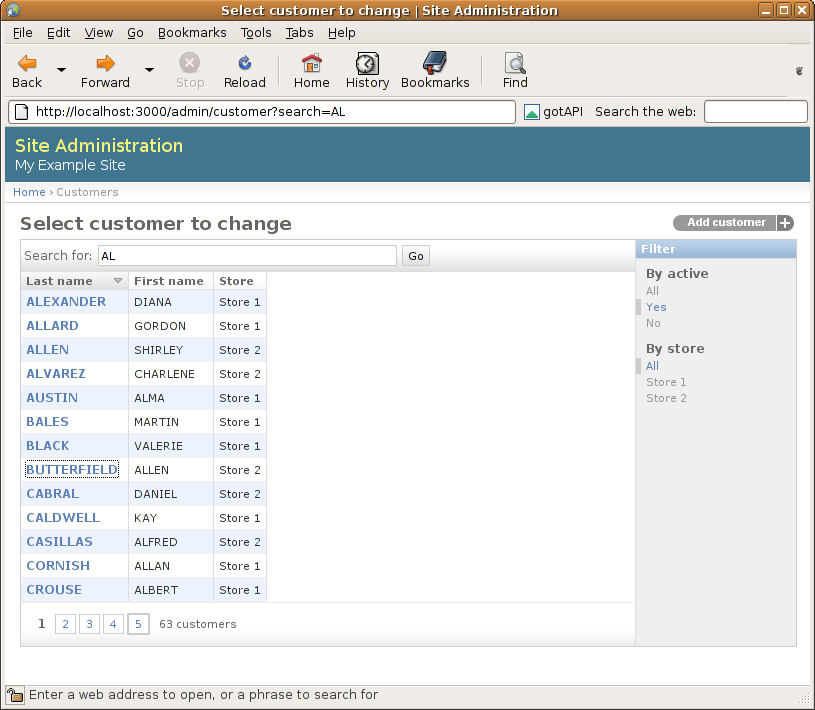
A plugin for Ruby on Rails that automagically creates an
administration interface, based on your models. It is heavily inspired
by the Django administration
system, and the only theme currently available is based directly on
Django's administration system. From the screenshots posted so far, it
appears to share goals with Streamlined.
Example?
  class Customer < ActiveRecord::Base
    belongs_to :store
    has_many :payments, :order => 'payment_date DESC'

    def name; first_name + ' ' + last_name; end

    sort_by :last_name
    search_by :first_name, :last_name
    filter_by :active, :store
    default_filter :active => true
    list_columns :store, :first_name, :last_name

    admin_fieldset do |b|
      b.text_field :first_name
      b.text_field :last_name
      b.select :store
    end
    admin_child_table 'Payments', :payments do |b|
      b.static_text :payment_date
      b.static_text :amount
    end
  end
What isn't it?
Scaffolding. This is not a view generator for you to then customise.
Either it provides the interface you want, or it doesn't. (With a
limited, but hopefully expanding, set of exceptions.)
For everyone. This is for applications that have a public interface
and a restricted-access administrative interface. Its goal is not to
generate views you would otherwise have to craft manually, so much as
generating views you otherwise wouldn't bother to create. Of course, a
neat side-effect of using this is that your boss (or your client's IT
manager) can make simple database-level changes that would otherwise
require a developer to use either the console or direct SQL. If you're
trying to create an interface for all your users, this probably isn't
for you.
Where is it?
Right now, there's just a tarball available at http://trebex.net/~matthew/auto-admin-0.0/auto-admin-0.0.tar.gz.
I need to get a public SVN repository set up for it, and populate a
useful Web page. Writing this has at least given me some material to
that end.
Is it usable?
Perhaps, but probably not quite yet. It currently doesn't like
editable sublists, for one, and it lacks a reliable set of tests... I've
TDDed a few features, but the tests covering the rest of the
functionality are rather sparse.
I'm releasing mostly for selfish reasons: I'm hoping that publishing
the code will shame me into fixing the nasty bits. :)
Other, more pressing, time constraints are forcing this release
before I get it cleaned up as much as I'd like (hence the lack of public
SVN or a website). An unfortunate side-effect of this is the timing with
respect to Streamlined's release. On that note, I'll be looking closely
at Streamlined upon its release, probably with a view to moving any
useful functionality I've built here into it; Justin and Stuart have far
more Rails experience than I do, and I expect that fact will be heavily
reflected in any comparison between this plugin and Streamlined.
What does it assume?
All objects it encounters can be usefully represented to a human as a
string. It achieves this by adding a to_label method to
Object, which will return the first available of
(label, name, to_s, or
inspect).
Your access control requirements for the administration section are
relatively "all or nothing". I intend to add simple class- and fieldset-
level declarative permission checking soonish (whenever I start to need
it). Access control based on querying individual objects should come at
some point, but I don't anticipate needing that level of control any
time soon. You can currently customise which fields are displayed (the
field list is a block of code, after all), but will end up with empty
fieldsets if you don't include any.
If you have any access control (which I expect will pretty much
always be the case), you must have a User constant, it must
respond to one of (authenticate, login, or
find_by_username_and_password), and that method must take two
strings, and return nil for failure or a non-false value for
success. It *should* return the authenticated user's model — if
the returned value responds to one or more of (active?,
enabled?, disabled?, and admin?), they
will be treated appropriately. The currently logged-in user (as returned
by the authentication function) will be looked for and stored in
session[:user], so if other parts of your site do the same,
things will Just Work. I'm concious of the fact that storing
ActiveRecord instances in the session is inadvisable, and
will probably change this sometime soon.
How do I use it?
Initially (after installing the plugin, obviously), you need to add a
few lines to the bottom of your environment.rb:
  AutoAdmin.config do |admin|
    # This information is used by the theme to construct a useful
    # header; the first parameter is the full URL of the main site, the
    # second is the displayed name of the site, and the third (optional)
    # parameter is the title for the administration site.
    admin.set_site_info 'http://www.example.tld/', 'example.tld'

    # "Primary Objects" are those for which lists should be directly
    # accessible from the home page.
    admin.primary_objects = %w(actor film user)

    admin.theme = :django # Optional; this is the default.
  end
Having done that, you can now (re-)start script/server, and
navigate to http://localhost:3000/admin/. Yes, it installs its
own routes. Yes, they're hard-coded. Yes, that needs to change... for
now, just don't try to use /admin/ for anything else.
:)
To customise which fields appear in the edit and list screens, you go
on to...
How does it work? - Part I, Declarative UI definition
The plugin adds a number of singleton methods to
ActiveRecord::Base, which permit you to declare how the
administration interface should behave.
This set of methods, which are quite central to the utility of the
plugin, have grown rather organically, over a period of time (as has my
Ruby-fu). I've attempted to clear out the most glaring API
inconsitencies, but it's still a bit of a mess. Some of the
implementations definitely leave a bit to be desired. Cleaning this up
is near the top of my TODO list. That said, it should all work.
:)
I really need to go through and write decent documentation for all
the published methods, but for now, the following summary should at
least act as a guide. Essentially, inside the model, you can use the
following methods:
- object_group(group_name)
- Declares which 'object group' this object belongs to, for use in
the interface. Currently, this is used to group together related
objects on the index page.
- sort_by(column, reverse=false)
- Instructs the list view to sort on the specified column by
default.
- search_by(*columns)
- Add rudimentary text searching across the named columns. Note that
this defines a
MyModel.search(many, query, options={})
wrapper around MyModel.find(many, options).
- filter_by(*columns)
- Allow filtering of the list screen by the named columns (filtering
currently works for: custom, boolean, date, belongs_to,
has_one, and string). Note that the last three will do
rather nasty and sub-optimal queries to determine the filter
options.
- default_filter(filters)
- Takes a hash of (column, value) pairs, to default a filter to
something other than 'All'.
- filter_options_for(column, choices, &block)
- Specifies a fixed set of choices to be offered as filter options
instead of automatically working it out. Choices should be a (value,
label) hash. The optional block will be given each value in turn, and
should return an SQL condition fragment.
- column_labels(labels)
- Takes a hash of (column, label) pairs, to change the default label
for a field to explicitly define the human label for a column. This
label will be the default used in both list and edit views.
- list_columns(*columns, &proc)
- Takes either a simple-list of column names, or a Field Definition
Block (see below)
- admin_fieldset(label='', *columns, &proc)
- Defines a fieldset for edit views. For simple use, you can just
give it a list of columns. Once you get started, you'll want to pass a
Field Definition Block, though.
- admin_child_table(label, collection, options={}, &proc)
- Defines a fieldset for edit views, to show a table of items from a
child collection. It uses a Field Definition Block to declare what
columns should be shown. Generally, you'd want to use the static_text
helper, I suspect.
WARNING: This has no tests, and I'm almost certain it will
break horribly if you try to use anything other than
static_text.
- admin_child_form(collection, options={}, &proc)
- Defines a "fieldset" for edit views, to show several
fieldsets, each containing one object from a child collection. It uses
a Field Definition Block to declare what columns should be shown. I
don't think it'd be wise to use this on a large collection, but it's
your application. :)
WARNING: This also has no tests, and I believe it will
break horribly if you try to use it at all.
Field Definition Block?!?
A number of the above methods provide for a block to declare what
fields are to be shown. This is achieved by yielding a builder to the
block. Depending on context, the mood of a theme author, and the phase
of the moon, a given block will see several builders in its lifetime.
Not all builders will have an active object; all will respond to the
object method, though. A basic field definition block will
just call a field helper on the builder for each field that it wishes to
display. The auto_field helper (which automatically
determines an appropriate field type based on column and association
metadata) is available if you only want to specify the field type for
some of the fields. All field helpers take (field_name,
options={}, *other_stuff). Most just take the two parameters, and
I'm considering deprecating the extra parameters on those that currently
support them. Note that unlike a standard builder, you don't have to do
anything with the return value; the theme's actual
FormBuilder is wrapped by a
DeclarativeFormBuilder, which takes care of that for you.
In theory, there's no compelling reason you can't add complex logic
to a field definition block, such as examining the current user, or even
the builder's active object (though I strongly encourage you to handle
nil permissively, at this stage). It would be unwise to vary the fields
returned based on the object for a list view, for fairly obvious
reasons.
Available Form Helpers
Simple helpers that just delegate to ActionView's
FormBuilder:
hidden_field, date_select,
datetime_select, text_field,
text_area, check_box
select and radio_group operate in basically the
same way; they both provide a method of selecting one out of several
choices (ignoring select :multiple, that is). Note that
select's list of choices, normally the second parameter to
the select helper, has been relegated to a
:choices entry in the options, for API
consistency.
static_text just outputs an HTML-escaped string
representation of the field's value. It is useful both for read-only
fields in forms, and as the primary helper in lists.
auto_field, as discussed above, will automatically select
a suitable field helper, based on the column and association metadata.
Where there are multiple suitable candidates, it tries to go for the
more generally-applicable choice (for example, it favours a
select over a radio_group for a
belongs_to association).
None of the following actually work, but they're defined, waiting for
me to come back and write them. html_area will eventually use
FCKeditor by default, and presumably the file/image fields will delegate
to file_column.
html_area, hyperlink, file_field,
image_field, static_image,
static_file, static_html
How does it work? - Part II, Themes
The theme bundled with the plugin is named 'django'; all
credit for its excellent appearance goes to the Django project. I hope
we can get a couple of standard themes, but they won't be coming from
me... experience shows that I shouldn't try to make things look good. I
believe I've successfully drawn lines in all the right places for what
is in the plugin's core, and what's in a theme. I've already developed
most of a second theme (which will not be released) for my employer, so
the infrastructure is mostly proven. A more coherent HOWTO on creating
themes (which can just be installed as seperate Rails plugins, then
selected in environment.rb) will be forthcoming Real Soon
Now, though this section has ended up covering most of the basics.
The 30 second summary — a theme comprises:
- FormBuilder (subclass of
AutoAdminSimpleTheme::FormBuilder), to create an Edit
screen (a real form)
- TableBuilder (subclass of
AutoAdmin::TableBuilder(FormBuilder)), to create a List
screen (a creative interpretation of "form", which seems to map
surprisingly well, for now).
- FormProcessor (subclass of
AutoAdminSimpleTheme::FormProcessor), which implements the
same set of helper methods as the FormBuilders, but instead
of returning HTML, its job is to perform any transformations on the
params hash to correspond with unusual form field
representations — the base FormProcessor transforms
keys referencing associations to reference the underlying columns
(actor -> actor_id), for example. This class
will often be empty, especially once I provide a facility with which
to inject custom field helpers (for composed_of and maybe
some belongs_to, mostly) into the base builder and
processor.
- A complete set of views, including a layout, which delegate the
hard work to the FormBuilders.
- A 'public' directory, containing any required image,
javascript, and stylesheet assets.
- A wrapper module, AutoAdmin#{name}Theme, which
is responsible for:
- Containing the FormBuilders and
FormProcessor
- Returning the full filesystem path to the 'views' and
'public' directories
- Returing any theme-specific helpers, for injection into the
controller
- Injecting any theme-specific includes for
ActiveRecord::Base (I've proven this to be possible,
though can't think of a sane reason a theme would want to do
so)
Extending your theme module with AutoAdmin::ThemeHelpers
will help to keep the module fairly DRY; it provides a helper
method, which can be given a list of modules and/or a block (much like
ActionController's), and directs the
view_directory and asset_root methods to a
directory(*subdirs) singleton method, which you must define
— presumably using __FILE__.
NB: For good reasons that I can't remember right now, a couple of
helper methods have APIs that don't match the standard Rails
FormBuilder, despite matching names. The one that comes to
mind is select — the choices have been moved into the
options hash, to keep all method signatures of the form
(field_name, options, *other_stuff).
What's planned, but missing?
Decent documentation. :)
The ability for the application to inject custom field types into the
base FormBuilder and FormProcessor. The
theme-specific versions of these classes are available so that, for
example, a theme can decide how a date_field should be
presented, and can correspondingly recover the values from multiple
inputs... they don't map as well to an application's requirement for a
'currency' field. Of course, there's nothing stopping an application
re-opening the classes and adding an appropriate helper method to
each... there's just a bit of undesirable complexity involved if you
want auto_field to detect and use it (which suggests to me
that auto_field needs a bit of a rethink).
A way for the application to reliably extend the
AutoAdminController, and add appropriate views somewhere, for
those occasions when you have a couple of screens that need to be
hand-crafted, such as a statistics display, or a particular edit screen
that needs a specialised workflow. Note that if you feel this
constraint too much, you're probably pushing the plugin into a role it
doesn't fit.
Simple methods allowing an application to add navigation options, and
perhaps the ability to insert Components into the "dashboard" on the
index page?
A top-level "menu", containing links to the primary object lists by
default, that a theme can permanently display.
It's probably a better idea to store the logged-in user's id, instead
of the user object, in the session.
Longer-term architectural considerations?
After starting off defining the administration interfaces directly in
the models (as Django does), I was strongly considering moving them all
into an application-specific controller, that would subclass
AutoAdminController. I haven't gotten around to doing that,
and am now quite intruiged by the approach taken by Streamlined —
adding a new type of class. Any such move is primarily aimed at solving
a problem I'm not yet sufferring, though, so for now it's just a topic
to ponder.
Author
Matthew Draper - matthew@trebex.net